Friday, July 16, 2010

ScissorTail


This spatial kinetic model is a progressive extension of the 'web' models we had been creating. We had been working largely with gears and other mechanical systems while creating our drawing machines but wanted to extend this exploration to generate more three dimensional or spatial gears. 

These kinetic models are articulated with intersecting planes, overlapping linear members, and pivoting points. These components interact creating mobile dynamic compositions that change. The challenge became to create strong compositions from all angles as well produce a mechanism that moves and 'sways' comfortably and elegantly.

Tuesday, July 6, 2010

Oil Spills


Our next study involves the mechanism as an architectural composition. It is a continuation of our study of mechanical gears with an added spatial dimension. We will be studying a combination of applied movements that originate as a formal composition and then reconfigure through the use of simple engineered guides, pivots, universal joints, and crank arms.

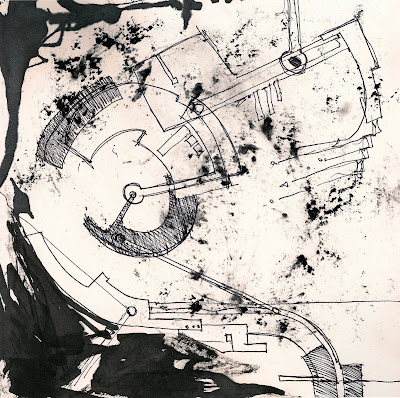
The sketches above are a series that begin to shape the possible compositions and given movements within the machines. There is also an explored notion of the machines being sited or attached in unique configurations based upon their movements.

Still working...


Thursday, July 1, 2010

...More Drawings


A few additional drawings from the first drawing machine with different armature locations on the cogs.

Wednesday, June 30, 2010

Drawing Machine Processing


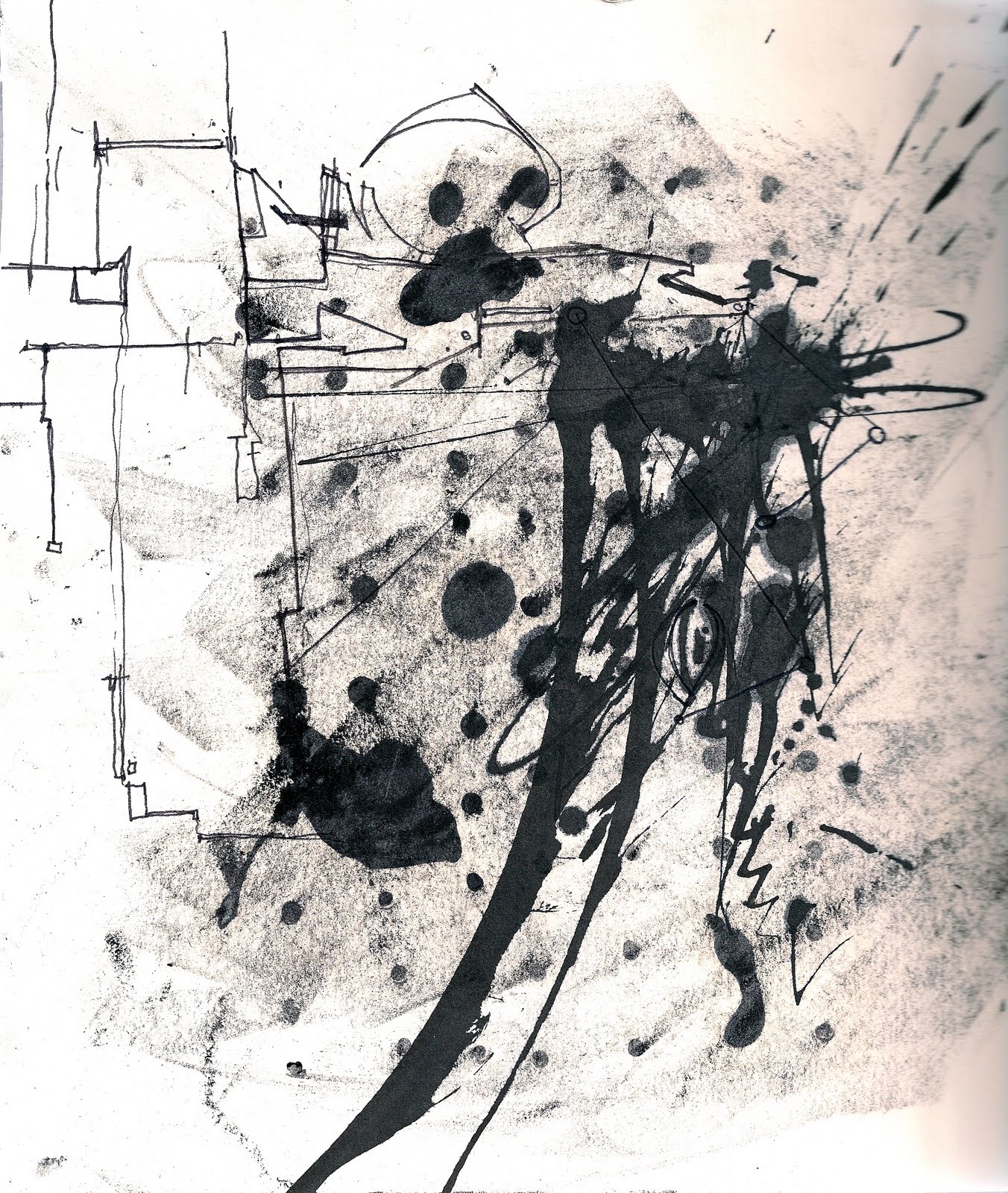
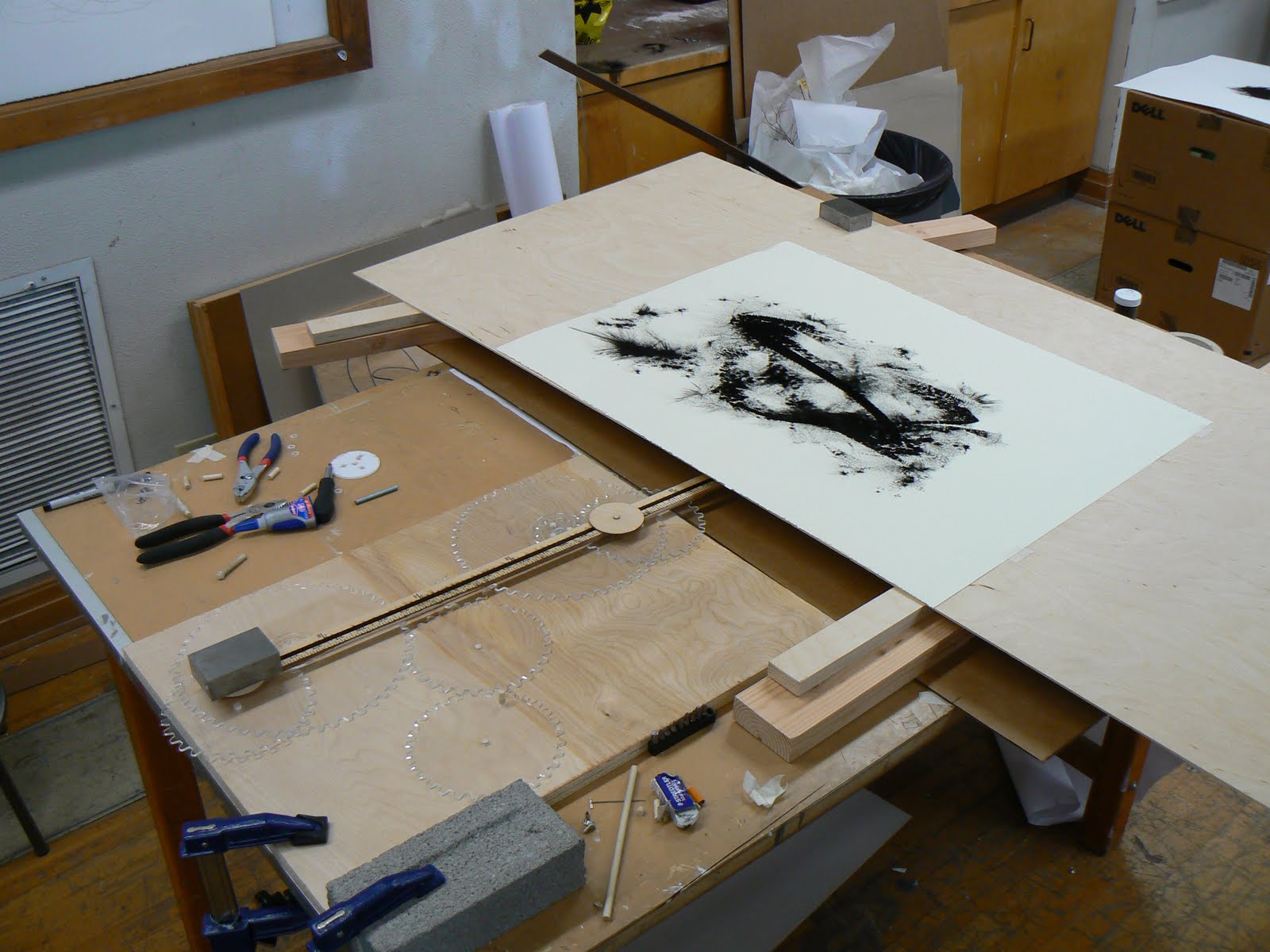
We have been mildly obsessed with the building of a drawing machine lately. The low-tech machine that produced these drawings is hand crank operated. The crank activates three other gears that control the left and right movement of the drawing arm as well as reach of the arm. The end product is a dynamic and spatial geometry that from afar reads as machine or computer animated drawing, but upon closer inspection reveals defects and 'squiggles' reminiscent of a free-hand drawing.

This duality is an important quality of the work we have been pursuing. Engineered machines are traditionally created to return functional needs, and rely on methods of manifest order, logical development, coherence through consistency and efficiency. In other words, machines traditionally pursue perfection. We wanted to create a drawing machine that made little messes and produced little defects. We believe the beauty of these drawings lies in their imperfections, a very human quality.

Machine 1

Machine 1 - We initially wanted to begin this studio with an experiment concerning the beauty of mechanized parts working together. The output of the machine is less important. The machine serves no function other than to engage the imagination of the observer. Light, reflection, materials, and method of kinetic motion became leading factors that informed the machine's design.